
Emergency Gas Engineer vs Regular Gas Engineer: What's the Difference and When Do You Need One?
It's 10pm in January. You get home, turn the heating on, and nothing happens. The boiler's dead. The house is cold. And you have no idea whether this is a job for tonight or a job for next week.
For most UK homeowners, a boiler breakdown is one of the most stressful domestic events they'll face. Not because it's dramatic, but because it's suddenly urgent in the most physical way possible — your home is cold, your hot water is gone, and the people you live with are uncomfortable. And in that moment, you need to know exactly what to do and who to call.
At Emergency Hero, we've handled tens of thousands of heating emergencies across the UK. We know what separates a situation that needs a qualified engineer at your door tonight from one that can wait until a weekday appointment. This guide shares everything we know — so you can make the right call, fast.
The UK's Boiler Problem Is Bigger Than You Think
There are around 23 million gas boilers in UK homes. More than 50% of boiler breakdowns happen in winter — which works out at roughly 2.5 million households losing their heating during the coldest months of the year. Research shows that 45% of UK homeowners have experienced a boiler breakdown during winter at an average cost of £940 per incident.
And yet most people have no plan for when it happens. They don't know who to call, they don't know what their boiler symptoms mean, and they waste precious time searching while the house gets colder.
Emergency Heating Engineer vs Regular Heating Engineer
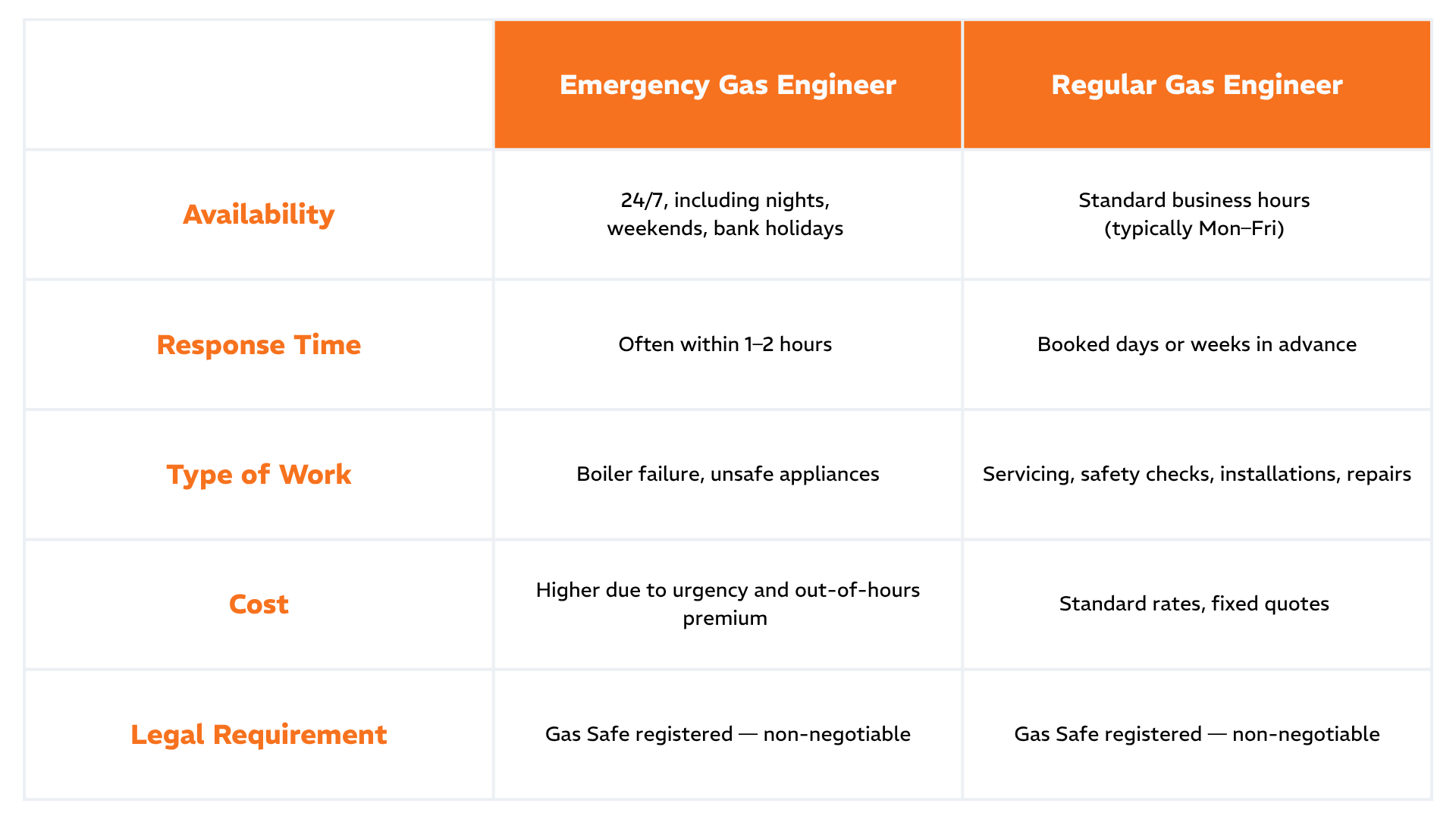
Both emergency and regular heating engineers are Gas Safe registered professionals. Both are qualified to diagnose faults, carry out repairs, and service boilers and central heating systems. The critical differences are availability, response time, and the type of problems they're best suited to.
An emergency heating engineer is on call 24/7 — nights, weekends, and bank holidays. They are dispatched fast, arrive equipped to diagnose and fix the most common heating faults on the spot, and are specifically set up for urgent, time-sensitive situations. When your home is cold and you can't wait, an emergency engineer is who you need.
A regular heating engineer works during standard business hours on a scheduled, appointment basis. They're ideal for annual boiler servicing, planned repairs, installations, and maintenance jobs where timing is flexible. They tend to cost less, because the urgency premium isn't there.
Think of it this way: a regular engineer is the professional you use to keep your heating system healthy. An emergency engineer is the professional you call when it lets you down.
The Differences At A Glance
When to Call an Emergency Heating Engineer
The honest answer: if your heating or hot water has stopped working and you can't reasonably live without it, that's an emergency. Here's a more detailed breakdown of situations that warrant a call-out today.
Complete boiler breakdown — no heat, no hot water
If your boiler has stopped producing heat and hot water entirely, especially during cold weather, this is an emergency. It's not a case of putting on an extra jumper and waiting until Monday — living without heating in a cold house has genuine health implications, particularly for children, elderly people, and anyone with a health condition. Many engineers will prioritise call-outs to households with vulnerable occupants.
At Emergency Hero, we treat complete loss of heating as an emergency regardless of the time of day. We'll have a Gas Safe registered engineer with you fast.
Boiler breakdown in winter
Boiler breakdowns in cold weather are exactly when engineers are busiest. If you wait, you may be waiting days — not hours. Acting quickly not only gets your heating back on sooner, it means you get a proper fix rather than a temporary patch. Our network of local, vetted engineers is available year-round, but our 90-minute response time matters most when it's cold outside.
Boiler breakdown with vulnerable people at home
If your home includes elderly relatives, very young children, someone who is pregnant, or anyone with a respiratory or cardiovascular condition, a loss of heating in cold conditions is a health risk. Don't wait. Call for an emergency engineer straight away and let us know when you contact us — we'll prioritise your call-out accordingly.
Boiler making unusual noises — banging, kettling, or rumbling
A boiler that starts making loud banging, kettling (a rumbling or whistling sound like a kettle), or grinding noises is telling you something is wrong internally. These sounds commonly indicate limescale build-up in the heat exchanger, a failing pump, air in the system, or low pressure. Left unaddressed, what's currently a repair can become a replacement. If the noises are sudden, persistent, or getting worse, treat it as an urgent fault and call us.
Boiler repeatedly losing pressure or locking out
A boiler that keeps dropping pressure, triggering fault codes, or locking out (shutting itself down) is not a boiler you can ignore and re-pressurise indefinitely. Repeated lockouts indicate an underlying fault — possibly a leak, a failing component, or a pressure relief valve that's releasing. Each time it trips, the risk of more serious damage increases. If it's happened more than once in a short period, get an engineer out.
No hot water during winter — boiler otherwise appearing to run
If your heating seems to be working but you've suddenly lost all hot water, this often points to a faulty diverter valve (in combi boilers), a failing thermostat, or an issue with the hot water circuit. Depending on your household circumstances, no hot water can be just as urgent as no heat.
Boiler visibly leaking water
Any leak from the boiler itself — dripping or pooling water around the unit — needs prompt attention. Leaks can originate from a corroded heat exchanger, a failed seal, or a faulty pressure relief valve. Left unchecked, even a small leak will cause water damage to surrounding areas and, in some boilers, can worsen quickly. This is not a "put a towel down and call next week" situation.
Frozen condensate pipe (winter)
Condensate pipes carry waste water from condensing boilers to the outside drain. In cold snaps, these can freeze — and when they do, the boiler typically locks out. Many homeowners can thaw a frozen condensate pipe themselves (gently, with warm water — never boiling), but if you're unsure or the boiler doesn't restart after thawing, call an engineer. A frozen condensate pipe is the most common cause of boiler failure in winter and can usually be sorted quickly by an experienced engineer.
Radiators cold at the bottom, or your heating system warming slowly
Cold patches at the bottom of radiators can indicate sludge and magnetite build-up in the system — a common issue in older central heating systems that reduces efficiency and can eventually damage the heat exchanger. If multiple radiators are affected, or if your system takes significantly longer than it used to warm your home, this needs professional diagnosis.
When Can You Wait and Book a Regular Gas Engineer?
Not everything needs someone there tonight. These situations are worth booking in as a standard appointment — you'll pay less, and there's no compromise on quality:
Annual boiler service — recommended every year by manufacturers and required to keep warranties valid. Most homeowners book this in September or October, before the heating season begins, while demand is lower and availability is better
Gas Safety Certificate (CP12) — legally required for rental properties every 12 months
Central heating not working in summer — inconvenient but rarely an emergency
Single cold radiator — often just needs bleeding; try that first
New boiler installation as a planned replacement
Fitting a new thermostat or smart controls
Power flushing the central heating system to remove sludge build-up — important to do, but rarely urgent
Persistent but minor drop in boiler pressure that can be manually corrected while you wait for an appointment
A good rule of thumb: if the problem affects your ability to keep your home warm and live comfortably, especially in cold weather, it's an emergency. If it's something you can manage around safely until next week, a standard booking will serve you just as well.
What Does an Emergency Gas Engineer Cost in the UK?
Emergency gas work costs more than scheduled work — the same principle applies here as for plumbing and electrical emergencies: you're paying for immediate availability, out-of-hours response, and the prevention of much more serious damage.
Indicative costs for 2026:
Standard gas engineer hourly rate: Typically £50–£100 per hour for planned work.
Emergency boiler repair call-out fee: £100–£250.
Average emergency boiler repair: £230–£750, with the average sitting around £410–£450. Parts costs are separate and can range from £100–£500 depending on the component.
Annual boiler service (non-emergency): £70–£120 — one of the most cost-effective investments a homeowner can make.
New boiler installation (emergency): £800–£2,500 depending on the unit and complexity.
The economics of gas maintenance are compelling. An annual boiler service costs roughly £90–£120 per year. The average emergency boiler repair runs to £400+. A single emergency call-out can cost more than four years of annual servicing. Regular maintenance isn't just about safety — it makes straightforward financial sense.
What To Do When Your Boiler Breaks Down
Before calling anyone, run through these quick checks — they solve a surprising number of apparent breakdowns:
Check the boiler pressure gauge — most boilers need to sit between 1 and 1.5 bar. If it's below 1, the system may just need repressurising via the filling loop (check your boiler manual for instructions)
Check the thermostat and timer settings — it sounds obvious, but incorrect thermostat settings cause a significant number of call-outs. Make sure the timer is set correctly and the temperature is above your room temperature
Check your electricity and gas supply — is the boiler receiving power? Has your gas supply been disrupted? Check other gas appliances
Check for fault codes — modern boilers display error codes when something goes wrong. Note the code displayed and mention it when you call us — it helps our engineers arrive with the right parts
Check the condensate pipe — in cold weather, look for a small pipe running from the boiler to the outside. If it looks iced over, this may be causing the lockout
If none of these resolve the issue, that's when you call Emergency Hero. Tell us the fault code if there is one, describe the symptoms, and let us know if there are any vulnerable people in the household. We'll have a Gas Safe registered engineer with you as fast as possible.
Why Gas Safe Registration Is Non-Negotiable
Every engineer who works on your boiler or central heating system must be Gas Safe registered. This is the law. It is not optional, and there are no exceptions.
The Gas Safe Register is the official government-approved register of heating and gas engineers in the UK. Gas Safe engineers are regularly assessed, hold specific qualifications for different types of work, and carry a Gas Safe ID card that shows their registration number and the appliances they are qualified to work on.
Always ask to see the Gas Safe ID card before any engineer begins work. If an engineer cannot produce one, do not allow them to proceed. You can verify any engineer's registration at gassaferegister.co.uk or by calling 0800 408 5500.
Every engineer in the Emergency Hero network is Gas Safe registered. We verify credentials before anyone joins our network, and we only work with professionals we would trust in our own homes.
What to Do in a Gas Emergency — Quick Reference
If you smell gas:
Don't operate any electrical switches
Open windows and doors
Turn off the gas at the meter
Leave the property
Call 0800 111 999
If your CO alarm sounds:
Leave the property immediately
Do not re-enter
Call 0800 111 999 or 999 if anyone is unwell
Seek medical attention if anyone has symptoms
If your boiler breaks down:
Check the basics first (pressure gauge, pilot light, thermostat settings)
If there is no gas smell or CO alarm, you may be able to wait for a regular engineer in milder weather
If vulnerable occupants are present in winter, call for an emergency engineer
How to Verify Your Gas Engineer's Credentials
This cannot be stressed strongly enough: every gas engineer who works on your appliances must be Gas Safe registered. This is not optional — it is the law.
Ask to see their Gas Safe ID card before any work begins. Every registered engineer carries one, updated annually, with their photo, expiry date, and list of appliances they are qualified to work on.
Verify the ID using the Gas Safe Register's 'Check an Engineer' tool at gassaferegister.co.uk — or call them on 0800 408 5500. You'll need the engineer's unique 7-digit licence number.
Be alert to the Gas Safe logo being misused — some unregistered traders display it on their vans and advertising. The only way to verify registration is to check the ID card or the register directly.
All gas engineers at Emergency Hero are Gas Safe registered and vetted before joining our network.
Why Regular Servicing Matters
The Gas Safety (Installation and Use) Regulations 1998 place clear legal responsibilities on landlords for annual gas safety checks — but all homeowners benefit from regular servicing. An annual boiler service by a Gas Safe engineer:
Checks gas pressure, combustion efficiency, and flue integrity
Identifies early-stage faults before they become dangerous or expensive
Keeps manufacturer warranties valid
Provides documented evidence of maintenance — relevant to insurance claims
Reduces the risk of CO exposure
The most effective defence against a gas emergency is regular, professional maintenance.
Why Choose Emergency Hero?
We work with a trusted network of Gas Safe registered, fully vetted gas engineers across the UK — local professionals who respond fast and know what they're doing. When you need an emergency gas engineer, we can have someone with you within 90 minutes in most cases. And we always send you a quote by text before any work starts, so there are no hidden costs.
87% of call-outs attended within 90 minutes
Gas Safe registered engineers — no exceptions
Available 24/7, 365 days a year
Transparent pricing — quote by SMS before work starts
Supporting local, trusted tradespeople across the UK
Facing a heating emergency? Don't wait — Find Your Hero now. Or if you can smell gas, call 0800 111 999 immediately.
Frequently Asked Questions
My boiler shows a fault code — what does that mean? Fault codes vary by manufacturer and model, but they're designed to help engineers diagnose problems quickly. Note the code and share it with us when you call — our engineers will often know immediately what the likely cause is, and can sometimes arrive with the right part already on the van.
Can I fix my boiler myself? Never attempt to repair a gas boiler yourself. It is illegal to carry out gas work without Gas Safe registration, and it's genuinely dangerous. There are a handful of things homeowners can do — repressurising, resetting, thawing a frozen condensate pipe with warm water — but anything involving the internal components of the boiler requires a qualified professional.
My boiler is over 15 years old. Is it worth repairing? It depends on the fault and the repair cost. As a general guide, boilers under 10–12 years old with a minor fault are usually worth repairing. For older boilers, or those that have already had multiple repairs, a replacement is often more cost-effective in the medium term. A good engineer will give you an honest assessment — and at Emergency Hero, honest advice is something we take seriously.
How long will an emergency boiler repair take? Most common faults can be diagnosed and repaired in 1–3 hours. More complex issues, or those requiring a specific part to be ordered, may take longer. Our engineers will always give you a realistic timeframe when they assess the job.
Should I get boiler cover? Boiler cover can be excellent value, particularly for older boilers or for landlords responsible for multiple properties. It typically provides priority call-out, covers parts and labour, and includes an annual service. If you have a breakdown before you've arranged cover, Emergency Hero is here. Once things are resolved, a cover plan is well worth considering for the future.
What's the best time of year to get my boiler serviced? September or October — before the heating season starts. Engineers are less busy, you'll find it easier to get an appointment at a convenient time, and you'll have confidence heading into winter that your system is in good shape.